Speaking

I speak about what I have learned and what I have lived: the shift from a deferrer society to a referrer society, glocal content systems like D:CAM and GME:X, AI in medical education, and what it means to write for language models as well as people. Broadcast taught me to make it land live, in plain words, for any audience. Every session below has a plain-English summary, with the key learnings one click away.

Book me to speak

Dr Kishan Rees speaking on stage at a Reuters Events panel, gesturing mid-sentence.
On stage at Reuters Events Barcelona, 2026 Photo: Reuters Events official photographer

2026

Reuters Pharma

Fireside: AI and Trust

Fireside chat · April 2026

A fireside stood up at 48 hours’ notice after a schedule change. We talked about trust as the speed limit on AI adoption, and what I learned embedding myself in a 72-hour hackathon built on two million synthetic patient records.

What were the key learnings?

My counterpart, a former global head of digital health at a top-five pharma company now in technology consulting, argued that AI moves at the speed of trust, and that trust operates at three levels at once: the data, the infrastructure it sits on, and the tools people actually touch. It is hard fought, hard won, and very easily lost.

The hackathon story: invited to judge, I felt a fraud assessing expert coders, so I negotiated to sit inside the event for 72 hours instead and watch how the building actually happens. Coding talent fused with healthcare purpose, working on synthetic patient records under personas and guardrails prepared weeks in advance, taught me more about risk-appropriate experimentation than any slide deck. Not everything built should reach production, and that is the point: test, learn and refine without the emotional investment that forces bad products through anyway.

We closed on judgement. Large language models are engineered to be agreeable, which is charming right up until you ask them about something you cannot verify yourself; my mechanic laughed at my AI car diagnosis, and health deserves better safeguards than my car does. The frontier models now emerging are dual-use in the way nuclear material is: enormous good or real harm, depending on how we guide them. Getting the best tools deployed safely, with guardrails, will change health around the world. I have no doubt about that.

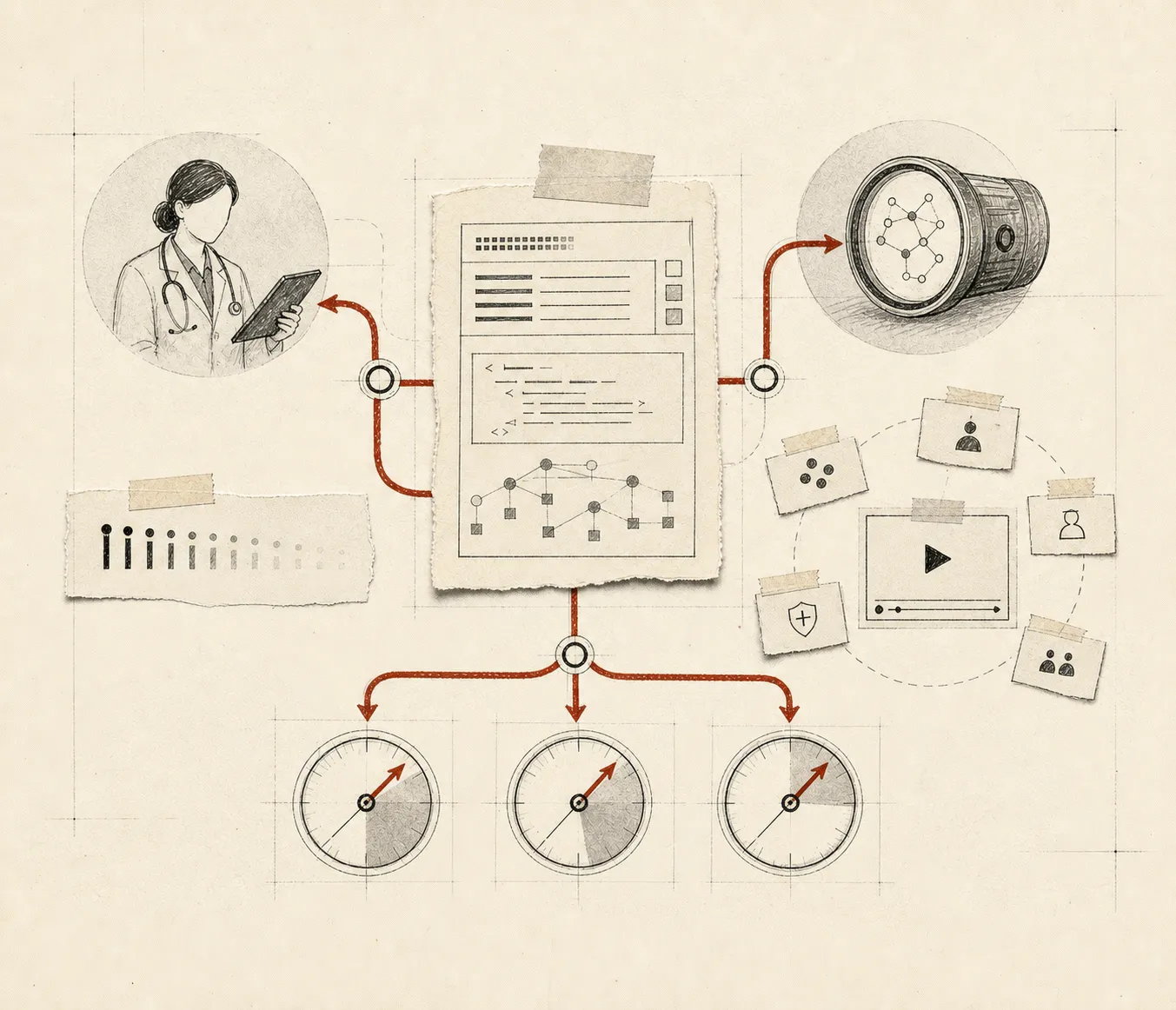
A hand presses a control panel atop a tiered card archive, ringed by a red boundary beside a compass.

Also on the bill

What Does Declining Web Traffic Mean for HCP Engagement?

Panellist · April 2026

Medical website traffic is down by around a third and clinicians’ use of language models has jumped towards universal. On this panel I argued we should stop optimising for channels we control, earn our way onto the channels clinicians actually use, and start writing for a third audience: the LLM itself. Business to business, business to consumer, and now B2LLM.

What were the key learnings?

Alongside an NHS consultant obstetrician and digital engagement leads from CSL and a regional pharma organisation, we looked at what AI-driven information seeking means for engaging healthcare professionals. The moderator’s firm, Syneos Health, had measured clinicians’ regular LLM use jumping from roughly 70 to 96 per cent in a year, while flagship medical websites lost around 30 per cent of their traffic.

My three measures for content that matters, replacing vanity metrics (judging content by clicks is like judging a surgeon by clinic footfall, it tells you nothing about outcomes): depth of engagement, behaviour change in the broadest sense, meaning the right patient on the right medicine and the wrong patient kept off it, and the relationship over time, the same clinician coming back across touchpoints.

On the open web: clinical content creators are filling gaps left by shrinking public health institutions, and for the industry not to engage with them is an open goal missed. When a major LLM launched its health product, traffic to pharmaceutical websites multiplied overnight, because the models treat that material as trusted source data. That is exactly why structured, credible content now has to serve human and machine readers alike. I closed with the Heart and Kidney Care Alliance, where Bayer provides the scaffolding and video frameworks while editorial control sits with twenty patient organisations around the world, as I put it on the day.

Digital Marketing World Forum

User and Employee Generated Content

Panellist · May 2026

A deliberate step outside pharma: a marketing conference panel on user-generated content, alongside leaders from travel, beauty and social-video intelligence. My message: authenticity is the whole game, and just because AI can mass-produce content does not mean anyone should.

What were the key learnings?

I was the healthcare voice among consumer brands, and the lessons travelled in both directions.

Mine to them: trust no longer flows hierarchically, it flows laterally, through people you know and voices you have chosen, which means the creator economy has immense potential for good in countering medical misinformation. And the best content moments are created, not commissioned: at a major cardiology congress in London we built a professional studio into the booth, unbranded bar a detail, and clinicians queued up to use it because it looked good, sounded good and got their message out.

Theirs to me: manufactured-organic campaigns that empower real customers rather than faking them, comment sections as the truest focus group, and hard evidence that audiences punish AI slop; in one analysis of Super Bowl reaction content, more than half the complaints about the adverts were about exactly that.

I also talked about turning colleagues into credible opinion leaders through consistent, authentic content (patients used to tell me the person they saw on Sky News was exactly the person in the A&E cubicle, and that consistency is the point), why we now actively look for ways to prove our content is not AI-generated, and a plea I made twice from the stage: these tools are addictive, so use them in moderation, for connection rather than doom-scrolling. Pharma’s regulation came up as a gift once again: the space around the product, like congress trailers and a journalistic health platform, is where the industry can innovate freely.

NEXT Medical Festival

Digitised Dependence Driving Doctored Truths

Workshop co-lead · 2026

An interactive workshop I co-led on medical misinformation: what it actually is, why falsehood travels six times faster than truth, and what a room full of life-sciences leaders could do about it. It ended with the launch of an alliance against misinformation in health.

What were the key learnings?

We opened with definitions that almost nobody I interviewed during my doctorate could give. Misinformation is factually wrong but shared without intent to deceive. Disinformation is wilful lying, for profit or narrative. Malinformation is the most insidious: nuggets of truth taken out of context and weaponised. Intent matters, because it changes how you counter each one.

Then the scale. A majority of healthcare professionals report losing patient trust to misinformation, around a fifth of patients have shared health content they later discovered was false, and MIT research shows false news spreads six times faster than truth, mostly shared by humans, not bots. Trust has migrated from experts, to systems, to strangers: it now flows peer to peer, laterally, which changes everything about how credible health information has to travel.

The response we proposed builds on the Alan Turing Institute’s framework of counselling, curbing and correcting: coach critical thinking before misinformation arrives (Finland teaches it in schools), slow the spread through conscious choices about what we share, and debunk where we see it, even over a coffee. Live audience polling surfaced the barriers (compliance, siloed functions, lack of trust) and the accelerants (patients, agility, authority). We closed by launching the Undoctored Truths Alliance, a cross-sector effort to unite the brilliant but siloed people already working on this, with patients involved from the start.

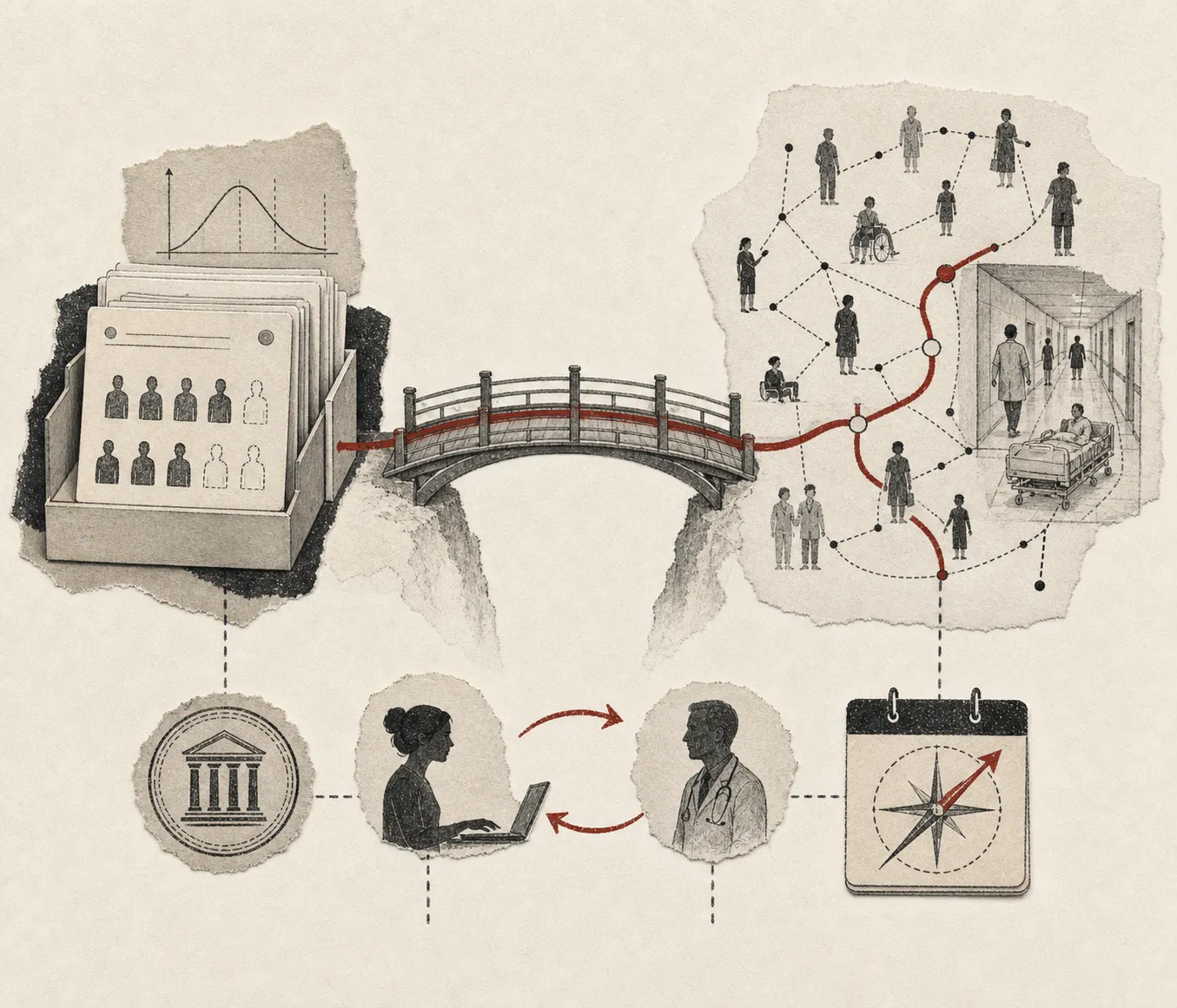
Torn-paper scraps feed a compass that channels a red thread into a spreading network of people, beside a coffee cup.
Watch the full talk YouTube

2025

Reuters Pharma

Dynamic Shared Ownership, Digital Marketing, Fast Feedback Loops and Driving Value

Co-presenter · 2025

Four speakers, twenty minutes, one main-stage slot: Bayer’s dynamic shared ownership model, the small teams it unlocks, and a UK marketing mix pilot that translated our digital work into the one language every stakeholder understands, sales impact.

What were the key learnings?

I opened on busting bureaucracy. Command-and-control hierarchies suffer execution erosion on the way down and information loss on the way up, and dynamic shared ownership replaces them with small teams built around the customer. Two of ours featured: the content-creation team known as the Filming Flamingos, and the tiger team that built this session, pairing Bayer colleagues with two external partners in analytics and marketing mix modelling.

The middle chapter was about bridging the chasm from early adopters to the late majority. Clicks and impressions persuade innovators; the late majority needs to see patient impact, HCP impact and sales impact. So we ran an affordable marketing mix modelling pilot in the UK, using region-by-region variation in activity and sales as natural test and control groups to attribute what each channel actually returns.

The result, in the qualitative terms I can share here: the new digital, brand-agnostic channels significantly outperformed the traditional ones on return, carried a meaningful share of growth, and the same analysis found real headroom in field-force targeting. Beyond the numbers, the professional broadcast environment has visibly strengthened relationships with the clinical experts we film with; they see how fast their message reaches the world.

American Association of Kidney Patients (AAKP) Global Summit on Kidney Disease Innovation

Elevating the Patient Voice Across R&D to Address Heart and Kidney Disease

Panellist · May 2025

I was invited by the Heart & Kidney Care Alliance, a Bayer-funded but fully patient-led initiative, to participate in a panel discussion at the 2025 Global Summit on Kidney Disease Innovation. We discussed what it takes to elevate the patient voice across research and development in heart and kidney disease.

What were the key learnings?

The Heart & Kidney Care Alliance is a Bayer-funded but patient-led initiative that brings together more than 22 patient organisations globally. This session put two of its chairs on stage: Uroš Bogdanović, a board member of IDF Europe, and Marc Bains, a co-founder of HeartLife. Colin Prout and I joined them from Bayer.

AAKP billed the 2025 summit as the midpoint reckoning of its Decade of the Kidney, 2020 to 2030: a decade spent raising the burden of kidney disease with communities, workforces and governments, and pushing past the status quo of downstream care towards patient choice, therapies that stop kidney disease before failure, and better access to donated organs and new devices. Our session’s brief sat inside that argument: a unified approach, with patients in the room, to how heart disease and kidney disease are researched and developed for.

2024

Reuters Customer Engagement

AI Debate: Dreamers vs Realists

Debate chair · 2024

I chaired this debate with a twist: panellists from Sanofi, AstraZeneca, Grünenthal and Within3 were assigned dreamer or realist positions, and only revealed their true colours at the end. Nearly everyone turned out to be a dreamer, grounded in realism.

What were the key learnings?

The motion: will AI fundamentally change how life sciences engages its customers within five years? Audience polls opened and closed the hour, with a strong majority backing “revolutionise” from the start, which handed the assigned realists the harder job.

The assigned positions produced genuinely useful arguments on both sides. For caution: pilots that never scale because the data foundations underneath them are missing, hallucinations that make the news and feed public mistrust, the ecological cost of AI at scale, and the fear people bring from a lifetime of science fiction. For ambition: the tech industry’s annual AI investment exceeding the combined R&D budgets of the top twenty pharmaceutical companies, compliant AI analysis of open-text feedback that had previously been too risky to collect, and consent done with full transparency, even at the cost of half a mailing list.

My summing up: keep humans in the loop. As a leading cardiologist once put it to me, a dodgy doctor harms one patient at a time; a dodgy algorithm harms thousands at a time. Generative AI is an even sharper knife than social media, so be careful how it is deployed. And the genie is out of the bottle: only a year earlier, most of the senior leaders at a round table I moderated had not even tried ChatGPT.

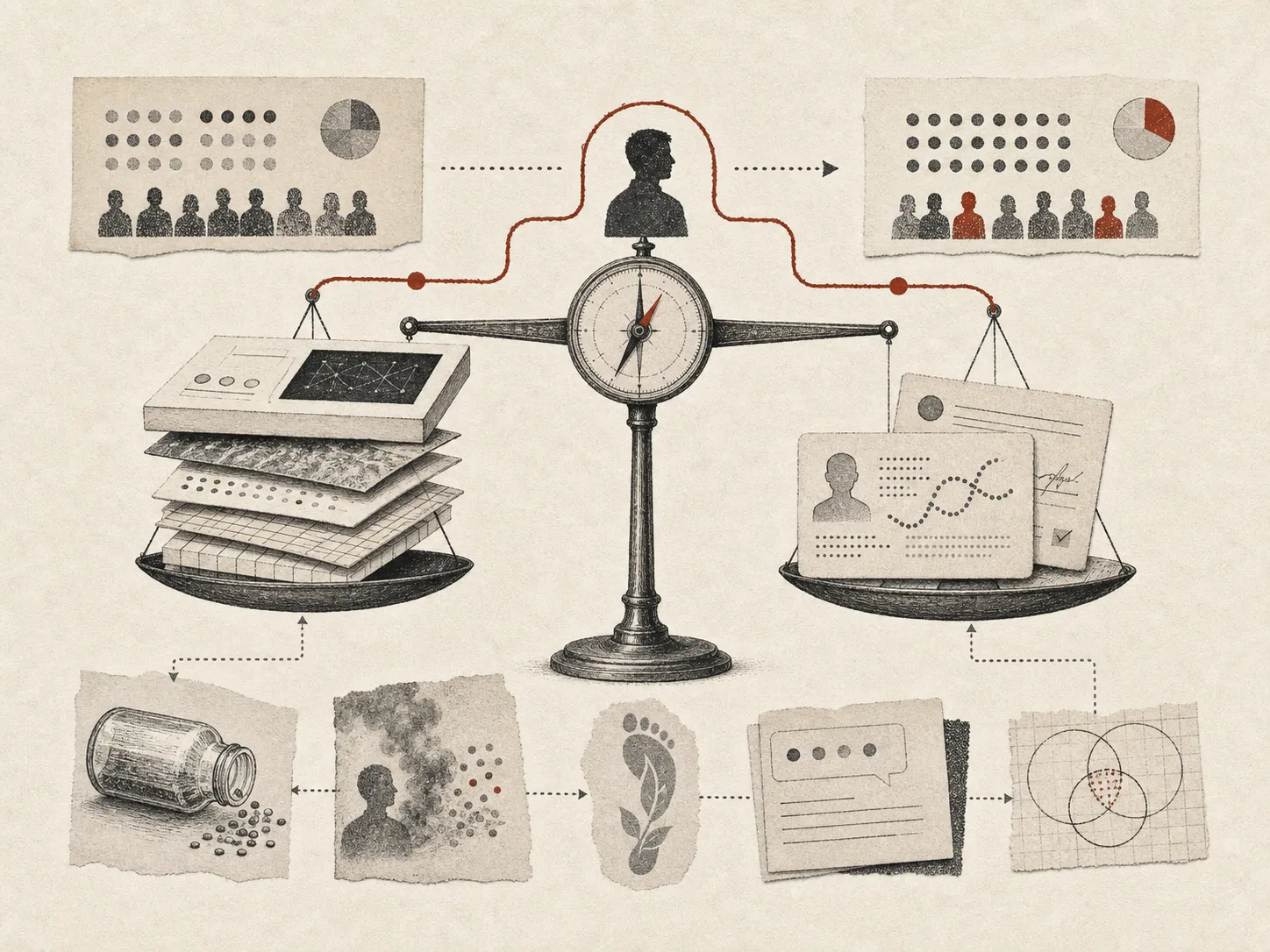
A balance scale crowned by a compass weighs a stack of data screens against machine-readable ID cards.

2023

Reuters webinars

Medical Affairs Data Centricity: Advanced Data Analysis for Patient Outcomes

Panellist · February 2023

A Reuters webinar on real-world evidence and advanced analytics, recorded weeks after ChatGPT launched. My take-home message for the audience was simple: go and try ChatGPT today, then tell your frontline colleagues about it, because these tools will change how medicine learns.

What were the key learnings?

Alongside senior medical affairs leaders in oncology and diabetes, we worked through why real-world evidence matters from the earliest phase: registration trials exclude the very populations clinicians actually treat, and regulators are increasingly open to real-world data, from the FDA’s 2018 framework to a medicine licensed in the US on real-world evidence alone.

My contributions: the Blockbuster Video warning I gave in one of my first pharma interviews, because believing you are too big to fail is exactly how you fail; investing for “the day after tomorrow” instead of perpetually firefighting yesterday’s mess; and the ACT on Heart Failure example, where mapping the patient pathway surfaced patients sitting on general wards with unidentified heart attacks, and where we transferred business-case and boardroom skills to clinicians rather than renting the system a nurse for a year.

I also argued for building capability rather than perpetually outsourcing: reverse mentoring from the digital natives coming through our organisations, and pharma-funded digital literacy for clinicians on the model of Barclays’ Digital Eagles campaign. Nobody goes to work wanting to do a bad job; these tools help people do a better one inside a strained system.

Is AI Set to Revolutionise Medical Affairs?

Moderator · September 2023

I moderated this webinar for a live audience of around 450, asking whether AI is set to revolutionise Medical Affairs. We dispelled myths, walked through use cases already running inside pharma, and explained hallucinations in plain language.

What were the key learnings?

The panel brought together leaders from Roche, GSK and Kite (Gilead’s cell-therapy arm), plus the chief executive of a medical-AI platform company. The framing that stuck: medical decision-makers are drowning in an ocean of information, and in this field wasted time equals wasted lives.

Use cases already live in 2023: AI-assisted literature review (medical knowledge doubles every 73 days), turning dashboards of KPIs into readable narratives for field teams, channel-preference models, next-best-action tools designed so the MSL stays in the driving seat, and chatbots giving patients reliable answers around the clock.

The governance half of the hour: hallucinations explained as an engine motivated to give an answer whether or not it knows one; focused, well-tuned datasets beating the one-model-to-rule-them-all approach; and the acceptance that you never fully de-risk AI, you mitigate it with human judgement in the loop. My close as moderator: the ship has sailed, so learn the tools, because the adage holds in Medical Affairs as much as in medicine. AI will not replace doctors, but doctors who use AI will replace doctors who do not.

Reuters Pharma, Barcelona

Glocalising Modular Content: How to Make It Happen

Panellist · April 2023

The closing panel of the day in Barcelona: how to make modular content genuinely work between global and local teams. My position: co-create early with markets, let local MSLs front the content, and never let global become an ivory tower.

What were the key learnings?

With medical affairs and scientific communications leaders from Takeda and Novartis, we unpacked “glocal” content: globally consistent, locally usable, and co-created rather than imposed.

My arguments: content forced on markets costs more downstream than co-creation costs up front, in sign-off time, localisation effort and lost ownership. Putting your own bright people on camera beats paying agencies for talking heads, because when every company uses the same agencies, all the materials look the same and differentiation dies. And education groundwork matters: at AstraZeneca, as a major cardiovascular outcomes trial read out, combining datasets showed the top UK GP search on Google was “what is type 2 diabetes and how do I diagnose it?”. Outcome-trial messaging lands on unprepared ground unless you walk people there first.

On AI, in the spring ChatGPT went mainstream: great for creative starts, but deployment has to be ethical, and as photorealistic synthesis arrives, human authenticity will become more valuable, not less. I also made the case for content repositories with institutional memory (stock-check before you commission), and for letting patient organisations co-create and rubber-stamp content rather than making everything purely on pharma’s terms.

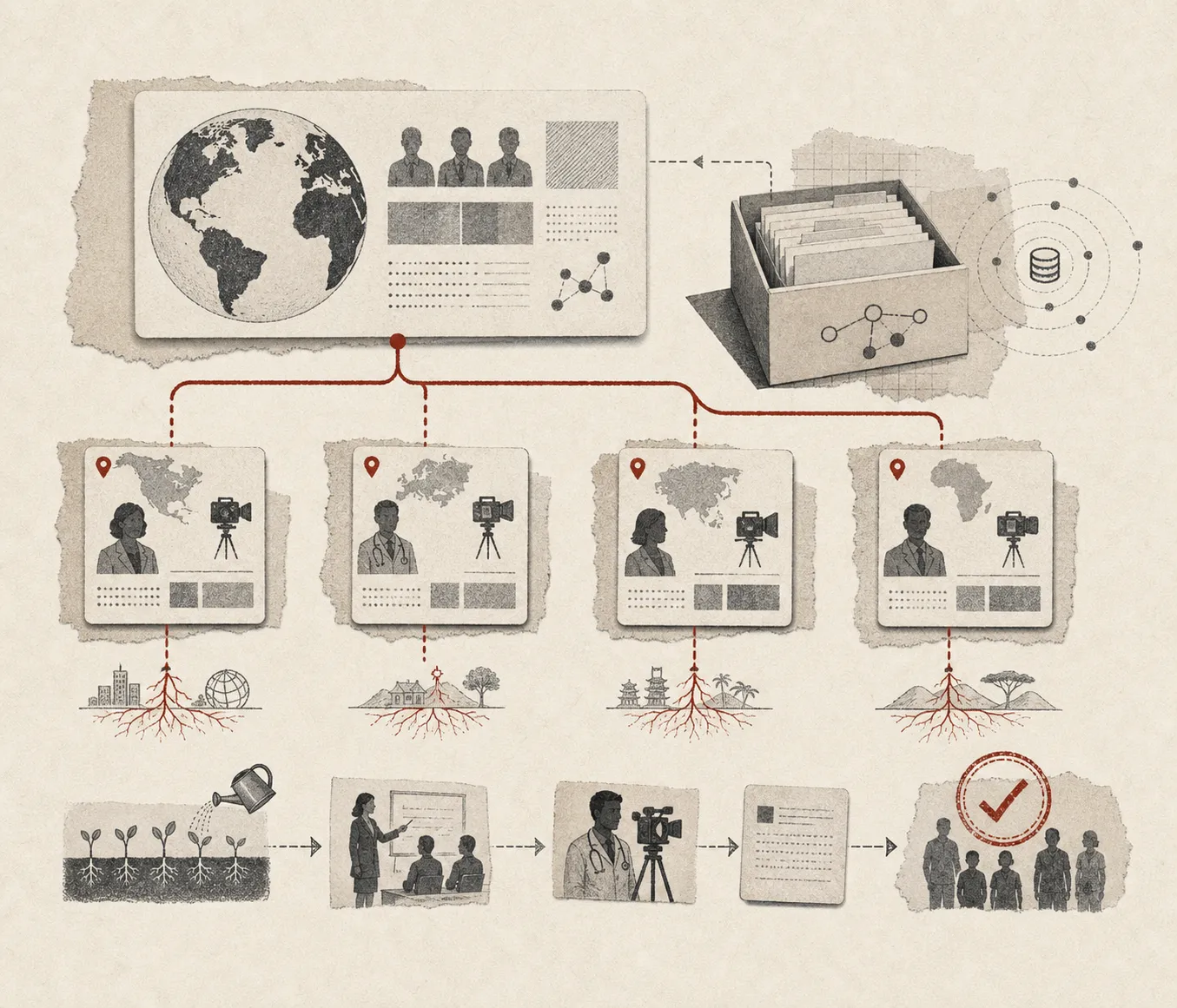
A globe master panel branches down red lines into four regional cards that put down roots in local landscapes.

Also on the bill

Medical: The Sales Prevention Unit?

Fireside chat · April 2023

A fireside chat named after what commercial teams once quietly called Medical Affairs. My answer from the stage: if preventing the wrong patient getting the wrong medicine is sales prevention, guilty as charged. The real question is how Medical and Commercial both get to do their jobs well.

What were the key learnings?

We traced where the label came from: the trust deficit of earlier decades, when incentives crossed lines and Medical earned a reputation for saying no, and the “no free lunch, no free pens” era I was trained in as a medical student.

My reframe: everything the industry publishes has to be balanced, accurate, referenced and substantiated, while my university lectures go through no peer review at all. I could tell students the sky is purple and some would write it down. That level of regulation is a strength to build on, not a brake.

The practical material: how I unblocked sign-off logjams by putting job-bag reviews into diaries, so the medical, commercial and regulatory reviewers all work at the same time instead of asynchronously over weeks; why strong medical leadership must own a consensus risk position rather than leaving sign-off to individual temperament; and the blue ocean where the Code does not prescribe, provided you stick to its principles. Two examples from my AstraZeneca days: a national pharmacy chain asked to use our content to teach its own pharmacists, and a primary care network played our patient films during the fifteen-minute observation window after COVID vaccinations, reaching some of the most vulnerable patients in the system.

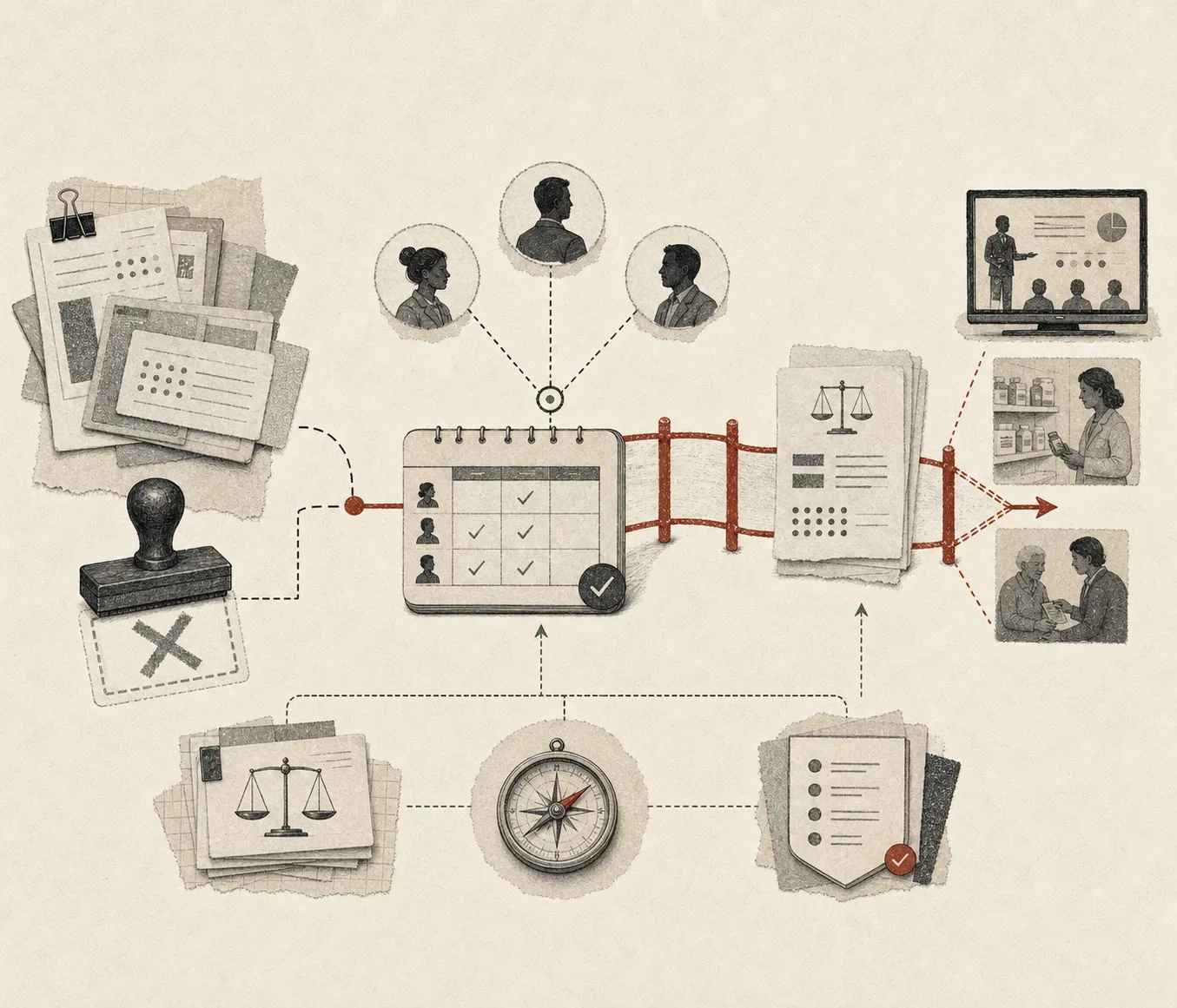
A rejection stamp and a ticked approval calendar sit behind a red barrier leading to a compliance document.

Also on the bill

Reuters Customer Engagement

Optimising Your Digital and Omnichannel Strategy

Panellist · November 2023

The final panel of the day, on keeping up with dynamic customer behaviours. My case: if a clinician wants exactly one channel, who are we to design an omnichannel journey around them? Listen first, run multiple small pilots, and scale only what works.

What were the key learnings?

Moderated by a global medical affairs head from Daiichi Sankyo, with commercial digital leaders from Novartis and ViiV Healthcare, the panel covered orchestration, segmentation, feedback and AI.

My contributions: the industry spends roughly ninety per cent of its budget on the ten per cent of healthcare professionals who already listen to us, so use cheap, democratised production to reach the wider clinical audience with content that actually helps. Demand less data up front: when we added a sign-up barrier in front of an education module in my AstraZeneca days, more than two thirds of 1,500 visitors dropped away. And trust your field force as an insight engine instead of hammering clinicians with surveys and feedback requests.

I also talked about cross-functional teams done properly, including a two-person “unusual marriage” of US Commercial and Global Medical Affairs that shipped a website in weeks, and gave a deliberately provocative take on AI: the companies building these models are the Apples and Googles of twenty years’ time, and an industry that is rightly regulated because it puts molecules into people’s bodies should take the lead in arguing that health-adjacent AI deserves the same standards. If we do not, we get disrupted again.

Pharmageddon, Barcelona

Pharmageddon

Fireside chat · 2023

Held under the Chatham House Rule, so no summary is published.

2022

Reuters Customer Engagement Europe, London

Digital Empowerment: The Key to Strategy Leadership

Panellist · 2022

My first Reuters panel, alongside leaders from Pfizer, ViiV Healthcare and Novo Nordisk: how Medical steps into the strategic leadership role it glimpsed during the pandemic. I opened with a story from my own time as a patient that shows how deep the industry’s trust deficit really runs.

What were the key learnings?

The panel asked what outcomes Medical should lead towards beyond trust. My opening story: lying in resus after coming off my bike in 2020, I asked to see a medicine’s Summary of Product Characteristics before accepting it, and the treating doctor told me not to worry about what the pharmaceutical industry “puts in there to scare you”. One doctor saying that to another doctor is the scale of the trust problem the industry faces.

My main arguments: trust has to be built internally as well as externally, because colleagues quite reasonably ask whether digital will replace them. It will not; humans buy from and sell to humans, and digital supplements the human interaction rather than substituting for it. Create safe, pressure-free opportunities for medical and commercial colleagues to get comfortable in front of a camera, instead of spending millions on third parties to do it for us. And think in “day after tomorrow” terms: Medical creates long-term value inside yearly budget cycles, so find your senior sponsor and be ready to accelerate when the moment comes. My phrase from the stage: be like seaweed on a rock, hang in there, because it will change.

We also covered measuring the quality of engagement rather than substituting sales metrics, content that stands alone in its own right (a heart failure module I worked on at AstraZeneca was so useful that a national pharmacy chain hosted it free, just for the traffic), and Medical’s role in redesigning patient pathways before somebody outside the industry does it first.

More Than Just Information: Upskilling MSLs to Become the Trusted Source

Panellist · 2022

The closing panel of the event, which I joined at short notice after two speakers dropped out. My argument: MSLs are the leaders of the future in engaging healthcare professionals, and my job leading them is servant leadership. What can I do to facilitate you?

What were the key learnings?

With global medical leaders from ViiV Healthcare and AstraZeneca, we dug into how Medical Science Liaisons become the trusted source rather than a hidden function most healthcare professionals do not even know exists.

My analogy from surgical training: the orthopaedic device rep stands at the surgeon’s side through the operation, trusted step by step. As medicines become more complex and the science harder for clinicians to stay on top of, the MSL is the perfect equivalent for prescribing decisions.

On the “haven’t MSLs always been trusted?” question: yes, but only by the small slice of top-tier opinion leaders who know they exist. The real work is equitable access. That means outreach (we went and spoke to the King’s College medical affairs Masters programme), replacing the slow no with a quick conversation about how to partner, and freeing specialist MSLs from geography, so the right expert can join any conversation in the country by video.

Also covered: digital empathy, meaning reading the room on a screen and matching the channel to the person; flipped-classroom engagement, so scarce face time is spent on meaningful conversation rather than content delivery; and pitching the science to the person’s level of understanding rather than dumping data.

Common questions

What does Dr Kishan Rees speak about?

The shift from a deferrer society to a referrer society in how people seek health knowledge; building glocal modular content systems such as D:CAM and GME:X; AI in medical education and medical affairs; countering medical misinformation; and Generative Engine Optimisation, treating language models as a third audience for content.

Where has he spoken?

He has spoken at Reuters Events conferences and webinars every year since 2022, in London and Barcelona, including chairing the 2024 debate AI: Dreamers vs Realists. In 2026 he also co-led a misinformation workshop at the NEXT Medical Festival and joined a content panel at the Digital Marketing World Forum.

How do I book him?

Email [email protected] with your event, dates and audience, and he will reply directly.

Something sparked your interest? Let's talk!